
Food Safety, Sustainability, and Trade: Getting the Trade-Off Right
Feeding the projected world population of 10 billion by 2025 is challenging. Keeping the balance between sustainability, food safety, trade, and better utilization of food already produced is crucial in achieving food security targets in the future. Intensification of current food production and adopting circular food systems are identified as part of the solution. However, the intrinsic desire to consume safe food without illness has always been the main concern and driver behind food safety regulations.
Global food transportation has increased exponentially since 1960, which outpaces food production. In the contemporary world, more countries are relying on international food trade. Agricultural trade has traditionally focused on raw materials and staples, but it has now shifted towards processed and branded products. Those changes in international trade led to the creation of dynamic and interconnected International Agro-Food Trade Networks. In many developed countries, these trade networks ensure food security and provide year-round access to food, but they also introduce vulnerabilities related to food safety and health by providing platform to the spread of hard-to-trace contaminants.
This article will explore the trade-offs involved in achieving the triple goals of sustainability, food safety, and trade. This work will argue that long-term objectives such as sustainability and food security goals must be achieved by ensuring food safety and developing countries participation in trade. Managing the trade-off between these objectives requires carefully crafted policies, evidence-based strategies, and innovative solutions. The perfect blend of food safety, trade, and inclusion of smallholders to the global value chain is essential to achieving the United Nations Sustainable Development Goals (SDGs).
Food Safety Regulations and Trade
The significant expansion of the agri-food sector has particularly benefited developing countries. However, ensuring food safety along the value chain remains a persistent concern. When considering international trade since the 1990s, the number of non-tariff measures (NTMs)[1] has tripled. Sanitary and phytosanitary measures (SPS)[2] had exponential growth in both product coverage and the number of implementing countries. Although food safety regulations in developed countries have been stringent for decades, SPS measures are increasingly being adopted by developing countries. Further private food safety standards [3]have also increased in exponential rate.
There is an argument among academics on whether food safety regulations serve the interests of public or protectionist agendas and whether those regulations and standards have a dual impact on trade. However, the empirical evidence does not allow for generalization of those results, as the literature is inconclusive on
[1] Non-tariff measures (NTMs); are policy measures other than tariffs that can potentially have an economic effect on international trade in goods
[2] Sanitary and phytosanitary (SPS) measures ; are quarantine and biosecurity measures which are applied to protect human, animal or plant life or health from risks arising from the introduction, establishment and spread of pests and diseases and from risks arising from additives, toxins and contaminants in food and feed.
[3] Private food safety standards; are generally set by private firms and standard setting coalitions and aim to facility supply chain management within an increasingly globalized and competitive international food market.
the overall effect of SPS measures, with some viewing them as trade barriers with a trade-impeding effect and others as trade catalysts with a positive effect on trade.
Research on the impact of private food safety standards on trade in developing countries indicates a dual effect as well. The high compliance costs may exclude developing countries from international markets and affect their comparative advantage. However, private safety standards can also encourage those economies to improve production processes and achieve productivity gains, which have a positive impact on trade. Additionally, private standards and regulations also dictate how producers position themselves in global value chains (GVCs)[1] which may ensure socially and environmentally sustainable income growth. Compliance with standards by trading partners promotes inclusion into the GVCs. Those often lead to comparatively higher wages, improved working conditions, better health and safety, enhanced environmental outcomes, and sometimes stronger trade unions. The standards based on markets in high-income or developed countries have a clear and often positive impact on achieving the SDGs related to income generation, gender inclusion, and environmental protection. However, it can also exclude small producers who were part of GVCs before, standards compliance may find themselves excluded, and the high demand and requirement of compliance can prevent small producers from entering the GVCs.
Sri Lanka GVC Participation in Food and Beverages
Sri Lanka’s current participation in GVCs amounts to $502.37 million in the food and beverages trade, with backward linkages accounting for $213 million and forward linkages for $288 million. The primary countries for backward linkages are India, China, Singapore, the United States, and Indonesia, while the key forward linkage countries are the Netherlands, Switzerland, the Maldives, Germany, and Belgium.
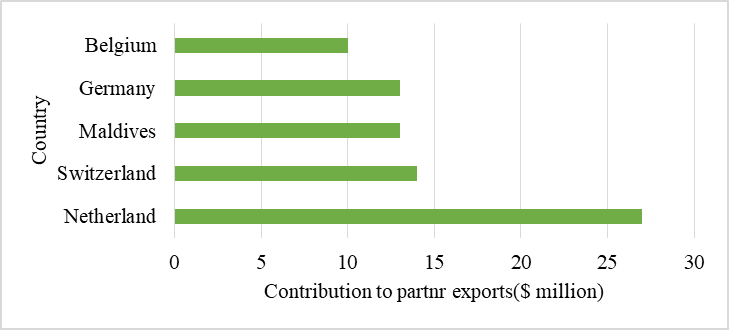
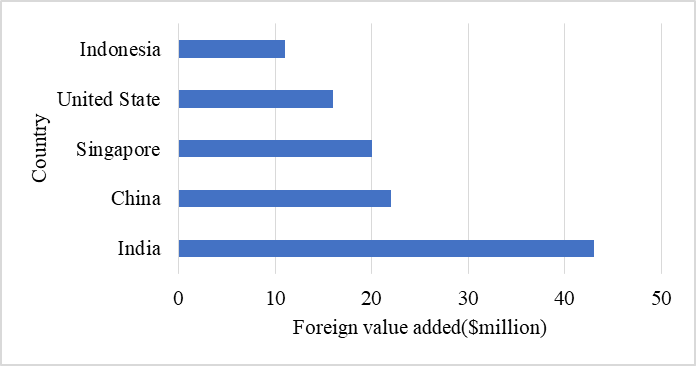
In trade with India, the majority of Sri Lanka’s GVC involves intermediate goods (54.43%), whereas with China, it primarily consists of finished goods (64.91%). The GVC participation index shows that Sri Lanka has the highest GVC participation with the Netherlands (0.43), Switzerland (0.40), and the Maldives (0.36) in the food and beverages sector. Overall, Sri Lanka’s value chain participation is highest with the Netherlands, totaling $31.15 million. However, Sri Lanka’s largest gross food and beverages exports, amounting to $217.96 million, are to India, with an overall GVC participation of $29.56 million in this sector, representing only 13.56%. These findings underscore the challenges developing economies like Sri Lanka face in effectively leveraging the power of GVCs.
A recent study in Sri Lanka by UNIDO[1] identified the benefits of developing the food safety landscape and food safety risk management improvements, would only significantly increase annual export values, with a projected 24% growth over the decade. However, outdated regulations, insufficient institutional coordination, and the lack of comprehensive monitoring practices from farm to table have left the country’s food safety systems in urgent need of reform which eventually benefit smallholder agriculture producers’ inclusion in international trade through GVC participation and, in the long run, contribute to achieving the SDGs.
Way forward
The standards in GVCs have a positive pull on the journey to achieving the SDGs. However, the impact is dual in nature. Compliance to standards support income growth, better working conditions, health and safety, gender inclusion, and environmental protection. However, they also create barriers, excluding small producers and less skilled workers from participation in global value chains.
In policy terms, aligning the standards more effectively with the SDGs is a must, and this will include promoting the inclusion of producers in GVCs through information sharing, reducing certification costs, enhancing the skills of marginalized populations for greater participation in standards-intensive GVCs, monitoring the effective implementation of GVC standards throughout the value chain, and assisting the producer access to the markets. Nonetheless, true success and sustainable development through food safety in GVCs require the active participation and awareness of every stakeholder in the value chain, as well as voluntary compliance with the standards and regulations by recognizing the true trade-offs involved
Key References
Kaplinsky, R. and Morris, M.H., 2017. How regulation and standards can support social and environmental dynamics in global value chains. Geneva, Switzerland: ICTSD. Available at: http://hdl.handle.net/11159/1649 [Accessed 14 Aug. 2024].
Perera, M.D.D., 2023. An overview of the food and beverages global value chain of Sri Lanka. In: Sri Lanka Association for the Advancement of Science, Proceedings of the 79th Annual Sessions. p.121. Available at: https://www.slaas.lk/images/annual_sessions/proceedings/ProceedingsPart-I-2023.pdf [Accessed 14 Aug. 2024].
Santeramo, F.G. and Lamonaca, E., 2022. On the trade effects of bilateral SPS measures in developed and developing countries. The World Economy, 45(10), pp.3109-3145. Available at: https://doi.org/10.1111/twec.13256 [Accessed 14 Aug. 2024].

Dilini Perera,
Research Officer,
Hector Kobbekaduwa Agrarian Research and Training Institute,
Colombo,Sri Lanka.