
Ecological Footprint and Biocapacity: As a tool to measure Sustainable Development
“Humanity is no longer living off nature’s interest, but drawing down its capital. This growing pressure on ecosystems is causing habitat destruction or degradation and permanent loss of productivity, threatening both biodiversity and human well-being.”
—WWF Living Planet Report, 2006-
1987, an urgent call was issued to the World Commission on Environment and Development by the General Assembly of the United Nations to develop a “global agenda for change” to address sustainability on a global scale. As a result, Our Common Future, also known as the Brundtland Report, was developed which is often referenced when exploring what the term “sustainability” means in a given context. Sustainable development was defined as “development that meets the needs of the present without compromising the ability of future generations to meet their own needs” (World Commission on Environment & Development, 1987). Thus, sustainability should serve both short-term and long-term goals while advancing environmental protection, social responsibility, and economic practices, while promoting public environmental awareness and action (Saxton, 2019). Many countries are exploring the way they are disturbing the ecosystem by using different kinds of methods. For example, desertification, deforestation, soil erosion, collapsing fishing grounds, pollution of the environment, encroaching habitat, carbon emission, and increasing atmospheric carbon dioxide are some of the problems that can affect the environment. All these results are generated by over-consumption or excessive waste generation of mankind.
To introduce a method to develop a common understanding of the sustainability problem and explore the implications of alternative solutions implemented after various efforts. As a result of this attention the term ‘Ecological Footprint’ was conceptualized and coined by Wackernagel and Rees and further developed by them and some others to assess the societal demands on the regenerative capacity of the biosphere. Originally, in 1992, Wackernagel and Rees termed the concept as “appropriated carrying capacity”, which was further renamed by Rees by the term “Ecological Footprint” in 1996.
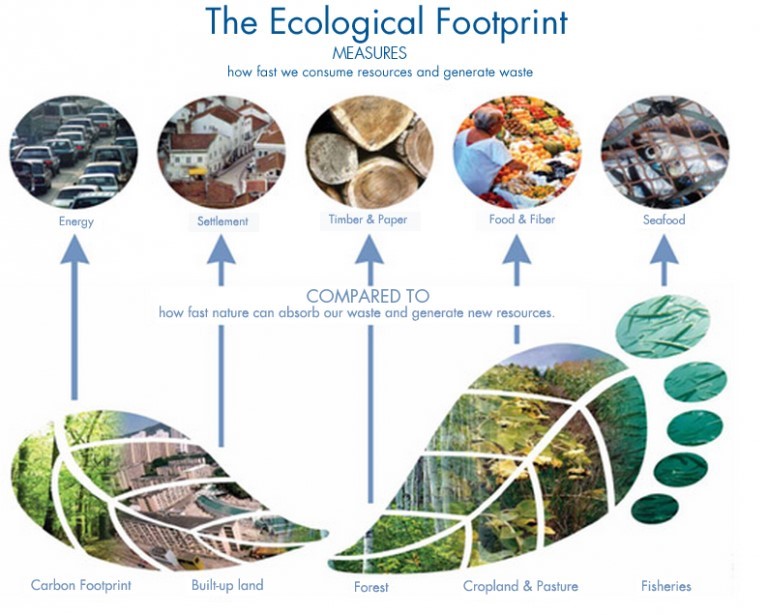
In early 1996, Wackernagel and Rees published the book “Our Ecological Footprint: Reducing Human Impact on the Earth”, after which the term got global recognition and acceptance (Goei et al., 2011). Specifically, the Ecological Footprint is calculated by taking basic forms of consumption – crops, meat, seafood, wood, fibre, energy, and living space – and converting them, at world average productivity, into six types of biologically productive land and sea space: cropland, forest land, grazing land, water area for seafood production, land for infrastructure, and land needed to absorb CO2 emissions from energy production (Dietz et al. 2007). In short, Ecological Footprint gives an idea about resources and energy consumption in a particular area or a particular group of people. Bio-capacity represents the biological productivity of that area. The ecological capital is depleting and/or waste is accumulating. The global ecological crisis is deepening. The trend paints a clear picture (Wackernage l, 1994). In the world, humans use as much ecological resources as if we lived on 1.75 Earths in 2019. The Ecological Footprint is the only metric that compares the resource demand of individuals, governments, and businesses against what Earth can renew.
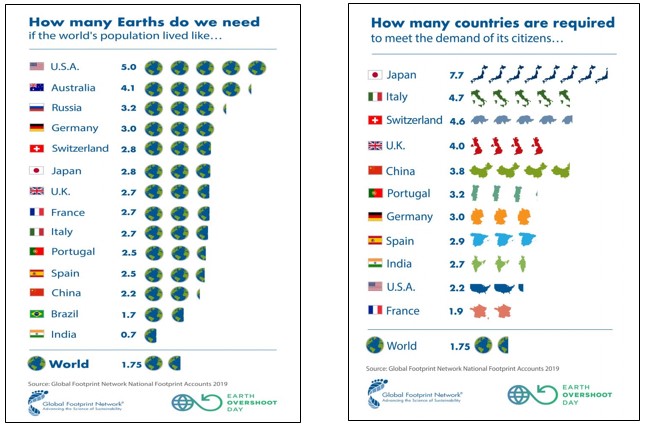
Breaking down global results by region reveals significant geographic differences in total and per capita Ecological Footprint trends. Perhaps the most striking trend is the rapid increase in Asia’s total Ecological Footprint since the 1980s, which is primarily driven by China. The Ecological Footprint per person in the Asia-Pacific region, although increasing, remains low and has stabilized in recent years. The total Ecological Footprints of Africa and the Middle East/Central Asia region are also increasing, with the per capita Middle East/Central Asia Ecological Footprint rising more rapidly than other regions. Africa’s per capita Ecological Footprint has remained stable and low across the timeline. Differences in total and per capita Ecological Footprint trends in Asia-Pacific and Africa (i.e., increasing total Ecological Footprint with a stable per capita Ecological Footprint), are indicative of significant human population growth in these regions (Lin et al. 2018).
Measuring Ecological Footprint and biocapacity may reveal how will be an urban context act out by measuring Ecological Footprint and biocapacity. Measuring Ecological footprint and biocapacity is a considerable scientific method made in the environmental statistical field from the perspective of conceptual tools for identification of the obstacles between sustainable development which can be understanding the flow between humans and nature and production and resources.
Key References
Dietz, T., Rosa, E. A., & York, R. (2007). Driving the human ecological footprint. Frontiers in Ecology and the Environment, 5(1), 13–18. https://doi.org/10.1890/1540-9295(2007)5[13:DTHEF]2.0.CO;2
Lin, D., Hanscom, L., Murthy, A., Galli, A., Evans, M., Neill, E., Mancini, M. S., Martindill, J., Medouar, F., & Huang, S. (2018). Ecological Footprint Accounting for Countries : Updates and Results of the National Footprint. 2012–2018. https://doi.org/10.3390/resources7030058
Saxton, M. W. (2019). The Ecological Footprints of Tiny Home Downsizers: An Exploratory Study. Virginia Tech Electronic Theses and Dissertations, April. https://doi.org/10.1017/CBO9781107415324.004
Schaefer, F., Luksch, U., Steinbach, N., Cabeça, J., Hanauer, J., & WWF. (2006). Ecological Footprint and Biocapacity: The world’s ability to regenerate resources and absorb waste in a limited time period. European Commission Report, 1–10.
Sonu, G., Binod, P., & Sonika, G. (2011). Ecological Footprint: A tool for measuring Sustainable development. International Journal of Environmental Sciences, 2(1), 140–144.
Wackernagel, M., Monfreda, C., Schulz, N. B., & Erb, K. (2004). Calculating national and global ecological footprint time series : resolving conceptual challenges. 21, 271–278. https://doi.org/10.1016/j.landusepol.2003.10.006
WWF (2016) Living Planet Report 2016. Risk and resilience in a new era, Gland

H. M. W. S. Herath, Demonstrator,
University of Kelaniya.