
Biomimicry: Nature Inspired Solutions.
We have deep connections with the natural world that imply inherent right to survive. It was not archived swiftly, it took eons to completely evolved or well adapted. These significant impacts force us to realize that everything is received from nature and eventually returned to nature. Nature designs the organisms and ecosystems to meet challenges sustainably by adaptation and strategies. This nature driven process changes the ways of thinking about the challenges to make a bridge between us and biodiversity with biomimicry. Biomimicry defines the practice of learning from nature’s time-tested ideas to solve human problems while generating more sustainable pathways. It provides a way of seeing and valuing biodiversity to gain more insight that ultimately describes the essential of human-nature connections.
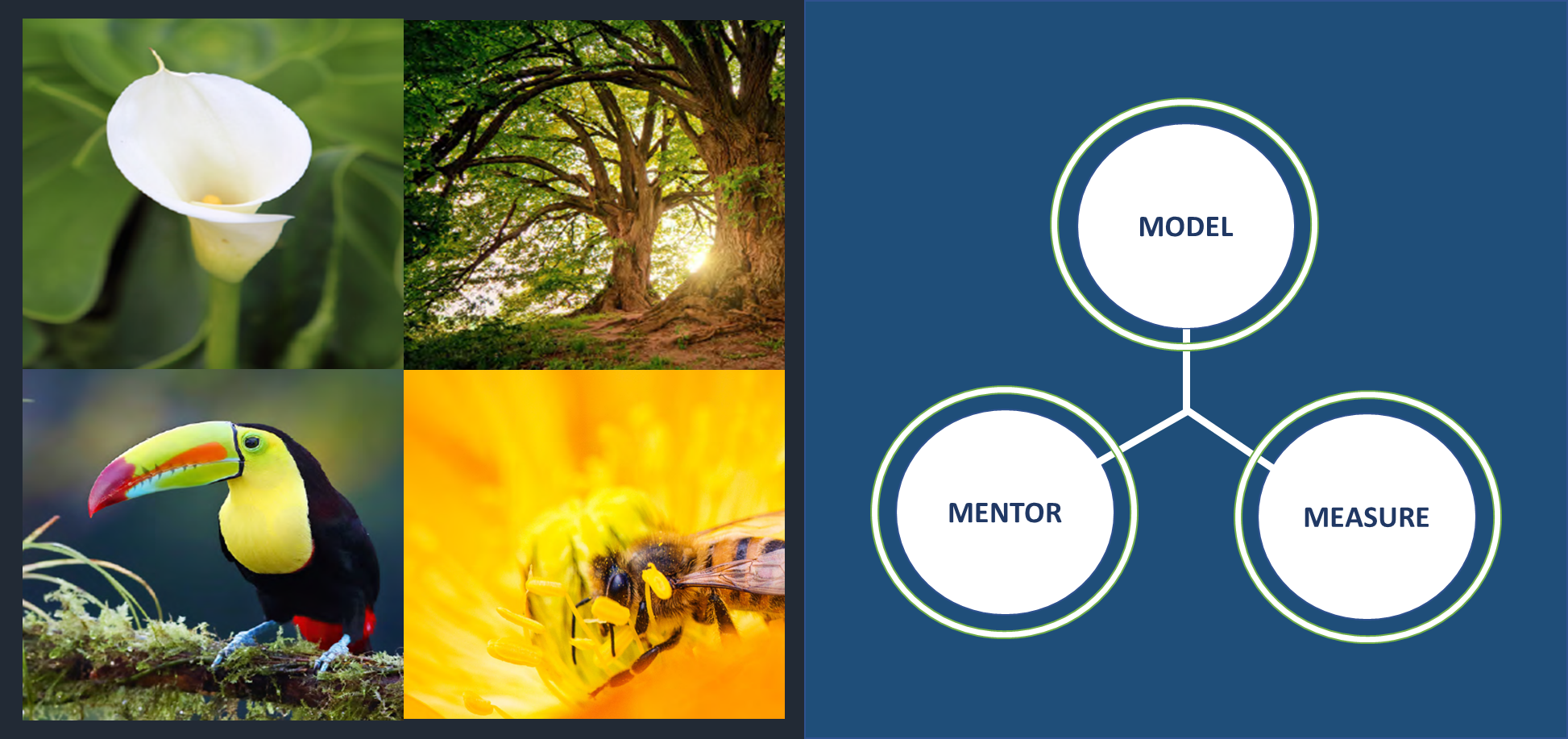
The inspiration from nature ignites the curiosity of anybody and everybody regardless their field to invent and innovate for expertise. Humans are still rediscovering for hopeful revolution and ideal environment. Unsurprisingly, the holistic manner of the ecosystem handle challenges by their eco-intelligence simultaneously. If you ask the question, is biomimicry new?… no, absolutely not. It is an ancient practice. Lu Ban designed the umbrella, derived inspiration from giant lily leaf and in 15th century Da Vinci closely observed the birds’ anatomy and flight to design a flying machine, known today as an aeroplane that was practiced and applied by Wright brothers. These ancient practices were re-ignited by Janine Benyus towards the emergence of modern biomimicry for hopeful revolution. The sustainability pressures on 21st century re-emerge the technologies to practice the nature as model, measure and mentor better than ever before. Through the lens of bio-inspiration, life’s principles are being followed by individuals and companies such as sustainable agriculture with permaculture, inspired by prairie ecosystem, efficient water and material mixing system, inspired by spiral flows, efficient and adaptive city, road mapping derived inspiration from slime mold, mycoremediation of toxic waste, inspired by fungi, circular economy derived inspiration from biological cycle, etc.
The seeds of biomimicry are practices by exploring, discovering, creating and evaluating to find the significance of nature for a specific problem. There are lots of new products, services and systems are designed and developed through life’s principles. In this context, there is a growing interest in biomimicry in Sri Lanka that is evident by research initiatives and overseas collaboration activities. To date, biomimicry is integrated into student’s curriculum and explored by project-based learning to invent and innovate. At the present context, the advantageous application of biomimicry offers a pathway towards sustainability and remains open for ensuring environmental and economic stability in Sri Lanka. However, nature gives us enough space to explore and integrate viable solutions for innovative strategies and sustainable life. Discover it, apply it and practice it.
“When we look at what is truly sustainable, the only real model that has worked over long periods is the natural world”
Key References
Aboulnaga, M. and Helmy, S.E. (2022) ‘Biomimicry in Criticism: Argument, Defense, and the Direction Toward Sustainability’, Biomimetic Architecture and Its Role in Developing Sustainable, Regenerative, and Livable Cities, pp. 411–454. Available at: https://doi.org/10.1007/978-3-031-08292-4_6.
Chheda, P., Kumar Sharma, P. and Dhir, A.K. (2024) ‘NEED FOR AWARENESS ABOUT THE FEATURES AND BENEFITS OF GREEN BUILDINGS IN ASIAN-SPECIFIC UNDERDEVELOPED NATIONS. A COMPRESSIVE REVIEW’. Available at: https://doi.org/10.33472/AFJBS.6.11.2024.942-958.
Gamage, A.U. (2015) ‘Exploring a Biomimicry Approach to Enhance Ecological Sustainability in Architecture’. Available at: https://ses.library.usyd.edu.au/handle/2123/14678 (Accessed: 8 August 2024).
What (really) is biomimicry? (2024). Available at: https://www.learnbiomimicry.com/blog/what-is-biomimicry (Accessed: 9 August 2024).
What are the benefits and challenges of applying biomimicry principles to product design and innovation? (2024). Available at: https://www.linkedin.com/advice/3/what-benefits-challenges-applying-biomimicry (Accessed: 8 August 2024).

Ms. Dharshika Sugumaran
Department of Biosystems Technology,
Faculty of Technology,
University of Sri Jayewardenepura.
+94 777 265 594