
Climate Risk Management and Mitigation- The Need of the Hour
Climate change is the defining topic of our time and we are at an important moment. Today, we face weather patterns that threaten our food production and rising sea levels that increase the risk of catastrophic flooding, so the impacts of climate change are pervasive and massive. Without extreme action today, adapting to these impacts in the future will be more difficult and costly.
Meantime it is noted that, global warming of 1.1°C above pre-industrial levels continues over a century by burning of fossil fuels and unequal, unsustainable energy and land use. Each rise of global warming marks in rapidly intensifying hazards, such as heavier rainfall, and other weather extremes that upsurge risks for human health and ecosystems
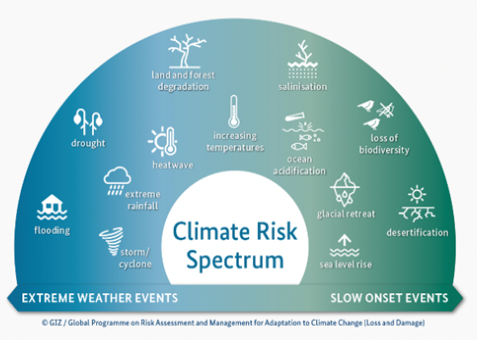
Hence, it is obvious that effects of climate change vary over a spectrum as shown in figure 1 above and some of them have been further elaborated below and can be considered as climate related risks which need to be managed and mitigated well.
Hotter temperatures
As greenhouse gas concentrations rise, so does the global surface temperature. Nearly all land areas are in more hot days and heat waves. Higher temperatures upsurge heat-related illnesses and make working outdoors more difficult.
More severe storms
Destructive storms have become more forceful and more recurrent in many regions. As temperatures rise, more moisture evaporates, which worsens extreme rainfall and flooding, producing more destructive storms and frequently destroy homes and communities, causing deaths and huge economic losses.
Increased drought
Climate change alters water availability, making it rarer in more regions. Global warming worsens water shortages in water-stressed regions and leads to an amplified risk of agricultural droughts disturbing crops, and ecological droughts increasing the vulnerability of ecosystems while limiting land for cultivation.
A warming, rising ocean
The ocean immerses up most of the heat from global warming. The rate at which the ocean is warming rapidly increased over the past two decades, across all depths of the ocean thus melting ice sheets leads sea levels to rise, threatening coastal and island communities.
Loss of species
Climate change increase risks to the existence of species on land and in the ocean. These risks upsurge as temperature rises. Worsened by climate change, the world is losing species at a rate 1,000 times greater than at any other time in recorded human history.
More health risks
Climate change is the biggest health threat facing humanity. Climate affects are already harming health, through air pollution, disease, extreme weather events, forced displacement, pressures on mental health, and
amplified hunger and poor nutrition in places where people cannot grow or find sufficient food. Extreme weather events increase deaths and make it problematic for health care systems to keep up.
Poverty and displacement
Climate change increases the potential that retain people in poverty. Floods may sweep away urban slums, homes and livelihoods and make it problematic to work in outdoor jobs. Over the past decade (2010–2019), weather-related events displaced an estimated 23.1 million people on average each year, leaving many more vulnerable to poverty.
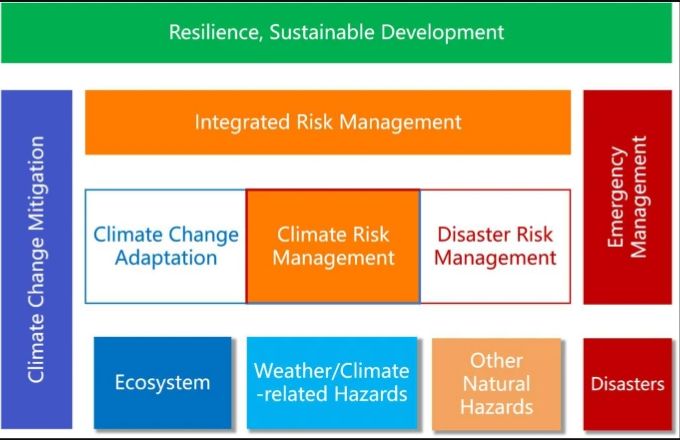
Therefore, as shown in figure 2 above, climate risk management has emerged as a serious aspect of corporate governance, demanding organizations to assess, adapt, and answer to the impacts of climate-related hazards/risks as well as at national levels. In response, businesses are gradually implementing climate risk management strategies to build resilience and ensure long-term sustainability. It is noted that climate risk management comprises the identification, assessment, and mitigation of risks associated with climate change.
Climate risks have implications for businesses, affecting operations, supply chains, financial performance, and reputation also a country. In addition, Gross Domestic Product of a country can also be affected. Hence, ignoring climate risks can lead to disturbances, making it imperative for companies to integrate climate risk management into their strategic planning processes. Here are some examples that demonstrate the potential costs of climate risks on businesses and organizations:
- Physical Risks:Hurricane Harvey in 2017 triggered an estimated U.S. $125 billion in damages, disrupting businesses and supply chains in Houston, Texas.
- Transition Risks: Volkswagenis planning to allocate almost U.S. $200 billion towards electric vehicles (EVs) and new technologies. This move highlights the automotive industry’s shift towards sustainable transportation and the transition risks businesses face due to policy changes and evolving consumer preferences.
- Supply Chain Disruptions: Unprecedented heatwaves in British Columbiatriggered the third-worst wildfire season and severe flooding, cutting off key transportation links to Canada’s largest port and causing lumber shortages and price hikes in the U.S.
Financial Performance: Peabody Energy’s bankruptcy in 2016 was partly due to the shift away from coal, underscoring the financial risks fossil fuel companies face amidst a global move towards renewable energy.
Climate risk assessments should consider both short-term and long-term risks, as well as secondary impacts on stakeholders, communities, and ecosystems. It is also observed that scientists generally consider policies relating to climate change under four broad categories.
1) Mitigation—efforts to reduce greenhouse gas emissions; E.g.: Use of renewable energy/low carbon clean energy sources, Eco-Friendly transportation system, conservation of water
2) Adaptation—increasing society’s capacity to cope with changes in climate; E.g.: Conserve & restoration of forests, Practicing of climate friendly gardening
3) Geoengineering or climate engineering—cautious manipulation of the earth system that is envisioned to answer at least some of the impacts of greenhouse gas emissions
4) Knowledge-based expansion—efforts to learn and understand more about the climate system, which can help support proactive risk management.
The following can be further implemented to reduce the effects of climate change thereby mitigate climate related risks at national and global levels.
1) Imposition of regulations related to climate mitigation;
2) Conductance of research, development, and deployment of new technologies;
3) Conservation of resources;
4) Efforts to increase public awareness;
5) Positive incentives to encourage choices that lower emissions;
6) Adding a price to greenhouse gas emissions, which creates incentives to reduce emissions
broadly.
As individuals, community, institutes, policy makers; we can play roles in reducing greenhouse gas emissions in our day to day life. In a nutshell, embedding climate risk considerations into decision-making processes is essential for actual risk management at national and global levels. Additionally, organizations and countries can integrate climate risk metrics and indicators into performance evaluations, financial analyses, and reporting mechanisms to confirm accountability and transparency. Therefore, climate change risk management is essential in modern day and it has become the need of the hour.
Key References
Causes and effects of climate change (no date) United Nations. Available at: https://www.un.org/en/climatechange/science/causes-effects-climate-change (Accessed: 08 August 2024).
Climate change (no date) United Nations. Available at: https://www.un.org/en/global-issues/climate-change (Accessed: 08 August 2024).
Climate change risk management (no date) American Meteorological Society. Available at: https://www.ametsoc.org/index.cfm/ams/policy/studies-analysis/climate-change-risk-management/#:~:text=Climate%20change%20risk%20management%20approaches,manipulation%20of%20the%20earth%20system (Accessed: 08 August 2024).
Pecb (no date) Climate risk management: Navigating the path to resilience with ISO standards, PECB. Available at: https://pecb.com/article/climate-risk-management-navigating-the-path-to-resilience-with-iso-standards (Accessed: 08 August 2024).
Sustainable earth (2022) climate risk spectrum. Available at: https://sustainable-earth.org/climate-risk-and-what-your-business-can-do/ (Accessed: 08 August 2024).
Wen, J. et al. (2023) a framework for addressing disaster and climate change risks in the context of resilient, sustainable development Available at: https://link.springer.com/article/10.1007/s13753-023-00472-3/figures/5 (Accessed: 08 August 2024).
Zabel, I. (2022) Ten ways you can mitigate climate change, Paleontological Research Institution. Available at: https://www.priweb.org/blog-post/ten-ways-you-can-mitigate-climate-change (Accessed: 08 August 2024).

Terancy Samarawickrama,
B.sc( Hons) ,MBA (UOC) m.IEPSL, m.IBIOL ( Sri Lanka), Green SL ® AssP,
Assistant Director-Environment,
Management Department of BOI Sri Lanka.